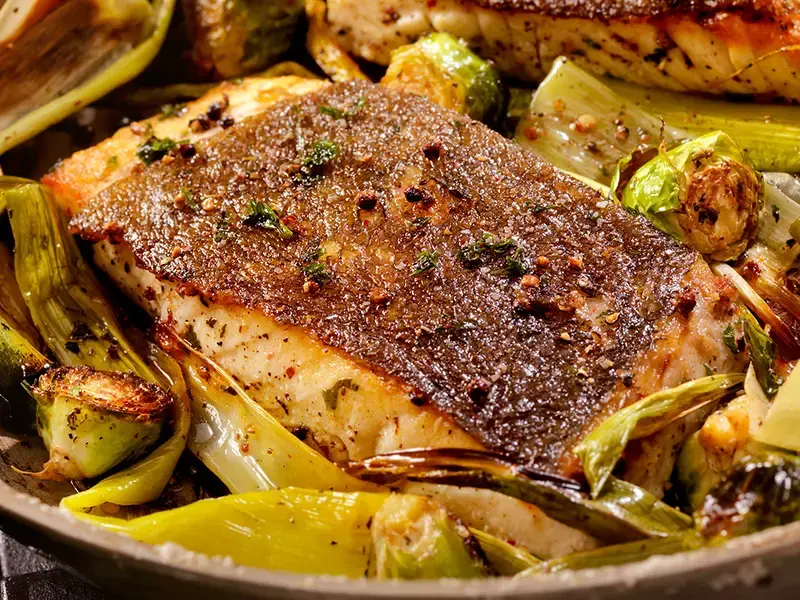
How to use parchment paper for perfectly crispy fish skin
Firstly, you want to bring your fish up to room temperature by taking it out of the fridge in advance of pan-frying. Moisture is the enemy here so dry your fish fillet well on both sides with kitchen paper. Season the fish with good quality salt and score the skin, gently – don’t cut too deep or you risk your fish breaking up in the pan.
Cut out a piece of grease-proof paper just a little bit bigger than the piece of fish. Fix the piece of paper to the non-stick pan, or a cast-iron skillet with a few drops of olive oil. Put a few more drops of oil on the other side of the paper and set the heat to high. Use a neutral cooking oil like avocado oil, rather than olive oil which has a low smoke temperature.
Place the piece of fish on the paper skin-side down and cook for a few minutes. Use a fish slice or a spatula to keep the fish flat against the paper and to ensure it doesn’t curl. Cook for five to six minutes, depending on the size and thickness of the fillet, until the skin is crispy and the flesh is opaque.
Turn the heat off and then flip the fish over to finish cooking. Leave until fully cooked right through. Cooking on one side is known as unilateral cooking and this method falls into that category. You should cook the fish 80% on the skin side and 20% on the flesh side. The paper can be reused for multiple fillets. Plate the fish, skin side up, garnish and serve.
This method works for frozen fish as well as it does for fresh fish. Frozen fish needs to be thoroughly defrosted before cooking and again, it is important to dry the surface of the fish before cooking.
You can use this method for cooking almost anything, including eggs, meat or vegetables. The parchment paper delivers an even sear on anything you’re cooking. Fish skin is delicious when it is cooked properly and it is also full of healthy nutrients like protein, omega-3 fatty acids and vitamin E.
You should always try and source the best quality fish possible, so develop a relationship with a specialist fish monger and buy wild-caught fish, rather than farmed fish. As the skin is the part of the fish that is exposed to the aqua culture in which it is raised, farmed fish can contain traces of contaminants.
You can eat the skin of almost any fish, but some fish like tuna, sword fish and monkfish have thick, leathery skin, so best avoided. Others like salmon, mackerel, halibut, sea bass, snapper and flounder are all delicious.